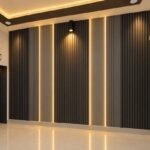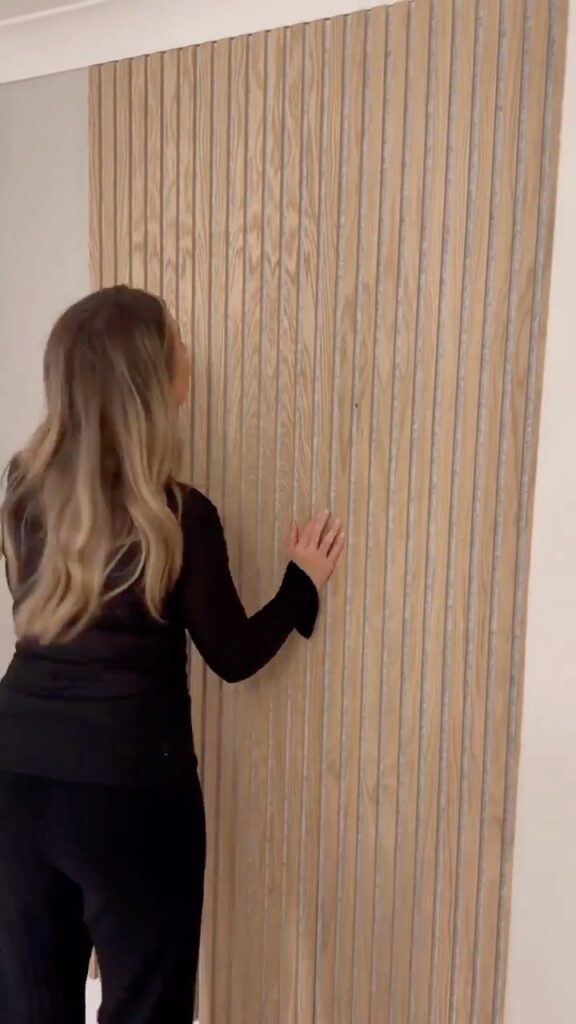
Acoustic wall design can be a weekend project with felt and adhesive, or it can run to custom CNC work priced by the square foot installed.
The deciding factor is whether the wall needs to disappear into the room or become its center of attention.
A 6 foot run of PET felt hangs alone with a level and squares; a parametric wave needs a firm to CNC spacers from your exact wall dimensions.
[link-whisper-related-posts]1. Wood Slat Panels with Absorber Backing
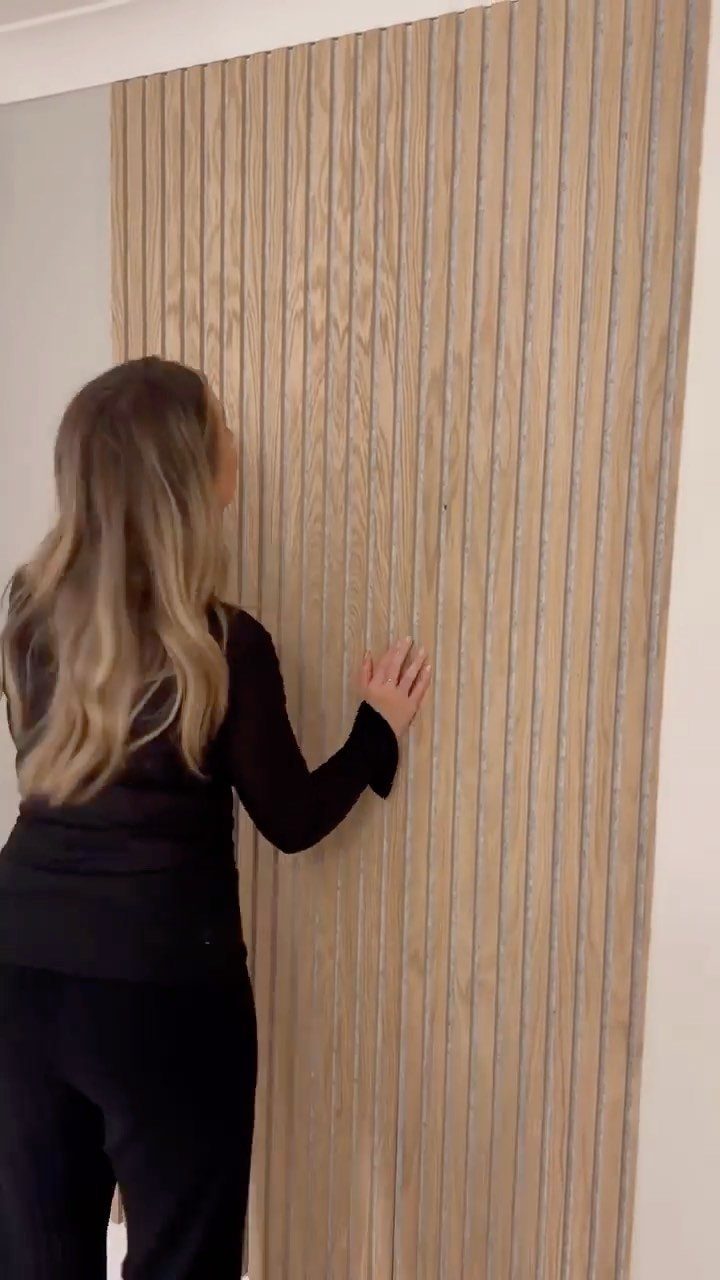
Wood slat panels with absorber backing give you the look of a finished wall and the sound control of a studio treatment in one piece.
The backing material matters more than the front; too thin and sound passes through, too thick and the panel sits proud of the wall in ways that trim has to solve.
I would check the backing depth against the slat spacing before ordering, since both affect how much echo the panel actually catches.
For renters, these mount with Z-clips or French cleats that leave only screw holes to patch later.
A weekend install runs about a thousand dollars for a full wall if you buy premade panels; building from MDF slats and Rockwool backing cuts that roughly in half but adds a full day.

High-Quality Wall Panels: Our acoustic panel set is crafted with high-density polyester fiber, premium medium-density fiberboard, and a solid wood veneer. This combination provides an elegant look, superior sound damping, and excellent sound deadening, significantly improving room acoustics
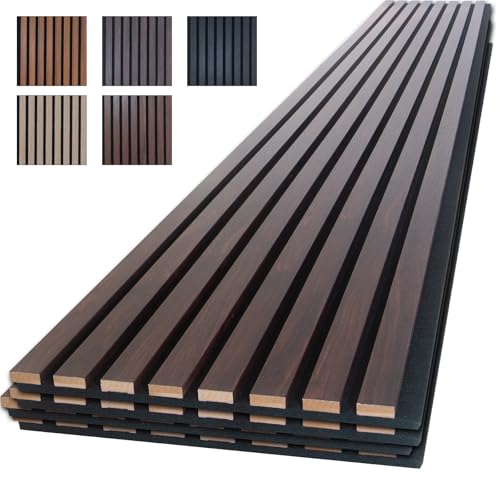
Modern and Elegant Design - The wood slat wall panels have been carefully designed to effortlessly transform any space, enhancing the surroundings both visually and acoustically. The wood panels help to create an environment that is not only quiet but beautifully contemporary, soothing and relaxing. Furthermore, our slat wall panels can be installed horizontally or vertically and cut to any shape allowing for creativity and a unique look to fit your aesthetics.
2. Felt-Based Acoustic Panels
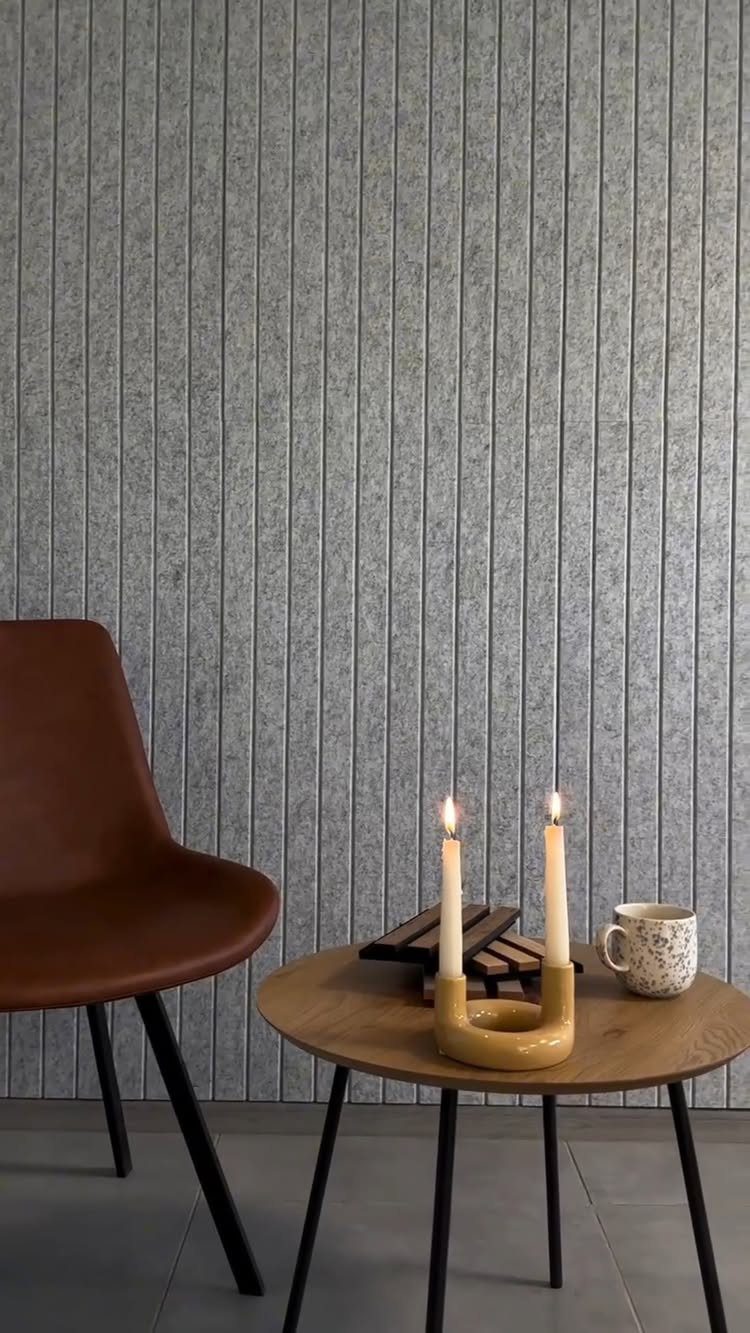
PET felt panels are light enough that I hung a 6 foot run alone with a level and adhesive squares.
Grey vertical panels suit a reading corner or home office where you want less bounce without the industrial look of foam wedges.
Standard felt panels cut echo noticeably, but that performance drops for low frequencies like bass or traffic rumble.
If your space has boomy bass from a soundbar or small speakers, you will need thicker felt or a hybrid setup with air gap behind. Cleaning means vacuuming with a brush attachment; scrubbing distorts the surface texture.
I would use these where the wall already has character and the panel should disappear into it, not where it needs to be the feature.

𝗪𝗵𝗮𝘁 𝗬𝗼𝘂 𝗚𝗲𝘁 - 16 acoustic panels covering 11.4 sq. ft. in total (each: 8 star panels 14.3" × 14.3", 8 cross panels 10.1" × 10.1"). At just 0.4" thick, they deliver powerful sound absorption without the bulk of traditional foam. Target exactly where the echo is worst – behind speakers, around your desk. Achieve both superior sound control and stunning visual impact.

Clearer room acoustics: Dense PET felt helps absorb reflected sound, reduce echo and control reverberation for a more comfortable listening environment in home offices, recording spaces, gaming rooms, bedrooms and media areas. These panels improve room acoustics; they are not designed to block sound transmission through walls.

Clearer room acoustics: Dense PET felt helps absorb reflected sound, reduce echo and control reverberation for a more comfortable listening environment in home offices, recording spaces, gaming rooms, bedrooms and media areas. These panels improve room acoustics; they are not designed to block sound transmission through walls.
3. Geometric Patterned Wall Panels
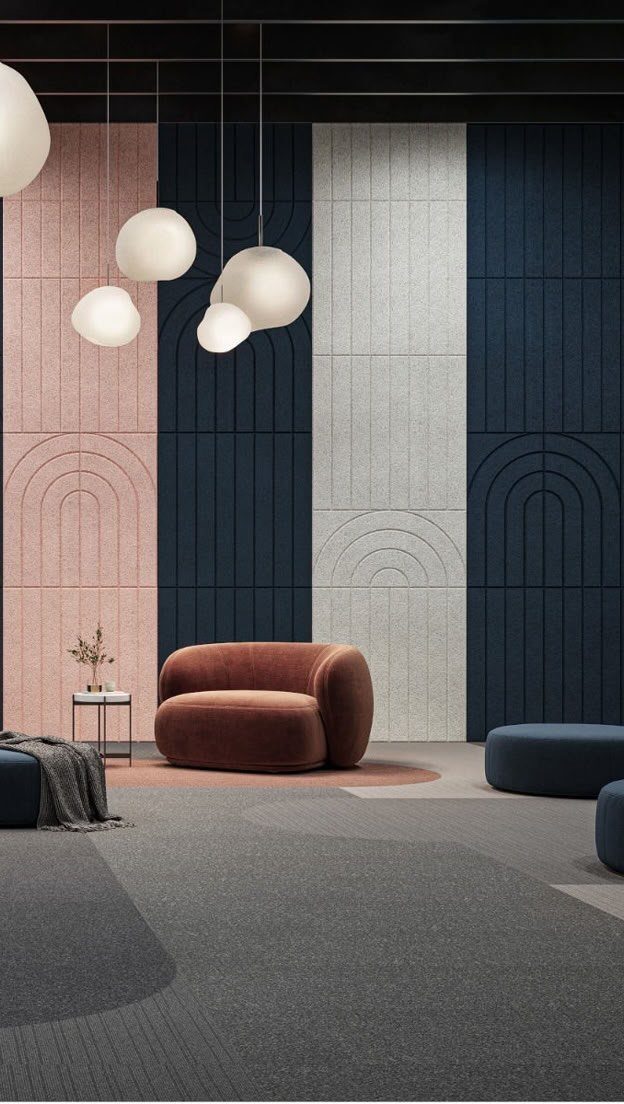
Geometric patterned panels let color do the acoustic work. Arched forms in pink, navy and off-white are fabric-wrapped composite, not paint on hardboard, so the absorption stays consistent across the pattern.
For a DIY route, I would order 2 foot by 4 foot fabric-wrapped tiles in 2 inch thickness and arrange them in a stepped or arched layout rather than carving custom shapes.
The depth behind the cutouts matters; flush mount loses the low-frequency control that makes the wall functional, not just decorative.
Dust with a vacuum brush. Wet cleaning on fabric faces risks water stains that show at an angle.

🎵 High-Efficiency Sound Absorption: The 2-inch thick acoustic panel delivers superior performance compared to ordinary 1-inch boards. It effectively absorbs noise and echoes, enriching music details and clarifying vocals for a professional acoustic experience.

Panel size is 24" x 48" x 2" and mounts flush to wall

Panel size is 24" x 36" x 2" and mounts flush to wall
4. Undulating Parametric Wood Slats
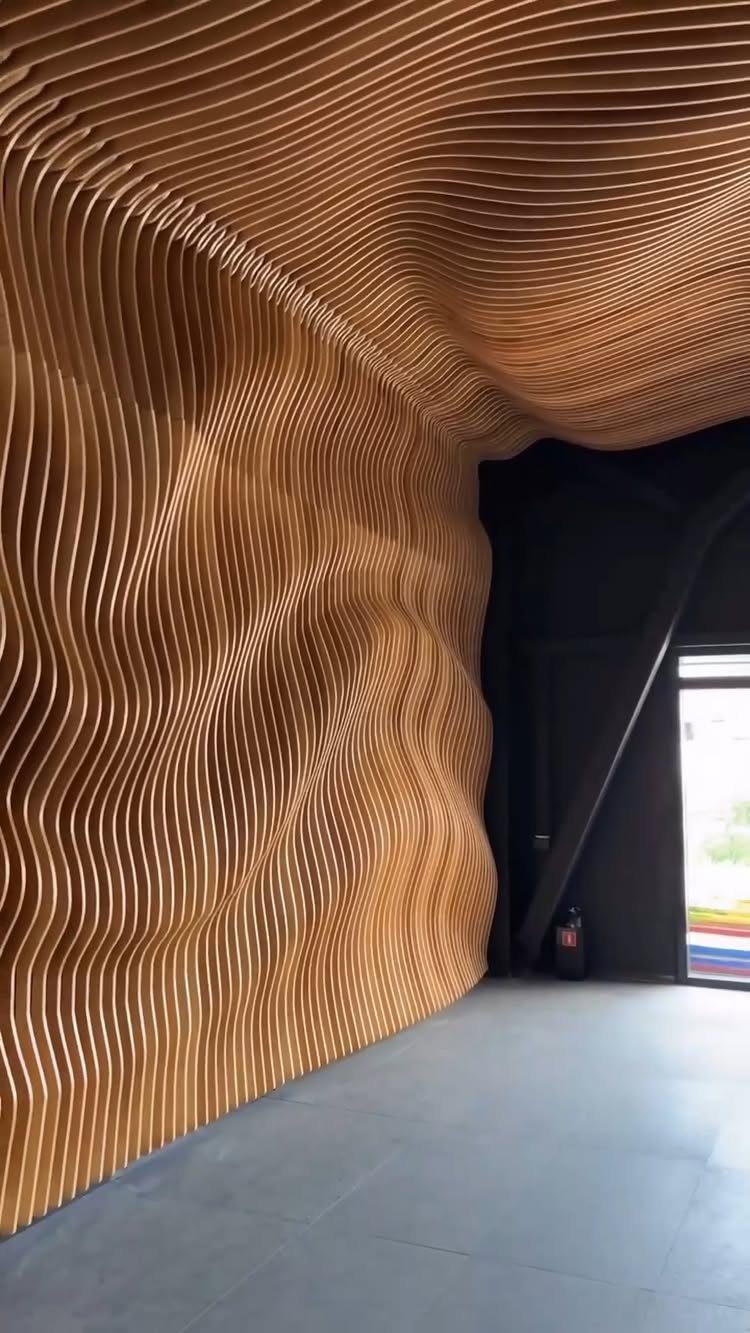
Undulating parametric slats are what happens when a wood slat wall stops behaving like a flat surface.
The wave form flows from wall to ceiling as one continuous installation, which means the rhythm of the curves has to resolve at the corner or the eye catches the mismatch.
I would not attempt this as a first project. The slats need individual spacers behind them to hold the curve, and the absorber backing has to be segmented or flexible enough to follow.
A parametric firm will CNC the spacers from your wall dimensions; budget starts high per square foot installed.
For a home version, I would scale down to a single accent wave over a sofa or desk, built from 1×2 pine slats on a plywood backer with a jigsaw curve.
The acoustic benefit is real but secondary; this is for the room where the wall is the point.

Real 3D Design: Diamond pattern with 1 inch raise design makes our wall panels more eye-catching. A box comes in 33 tiles, which covers 32.Sq.Ft.

Focus Catalyst, Turn Distractions into Deep Work: 95% noise reduction (NRC 0.95) isn’t just specs—it’s reclaiming focus. Cut street noise, echo, and distractions in working or study space, turning scattered workdays into 4-hour deep work sprints. No more ‘sorry, can you repeat that?’ in video calls—just pure, uninterrupted concentration.

CIRCLE PUNCH: MODERN GEOMETRY THAT WORKS - Clean circular cutouts run across the panel in a precise grid — a geometric pattern that lands somewhere between modern art and architectural detail. Precision-carved into dense PET with a printed PVC wood grain surface. The round openings catch and release light differently throughout the day, giving the wall a subtle kinetic feel. No flat wall can do what Circle does. It is pattern with purpose — visual rhythm that makes a room feel intentional
5. Backlit Concentric Acoustic Design
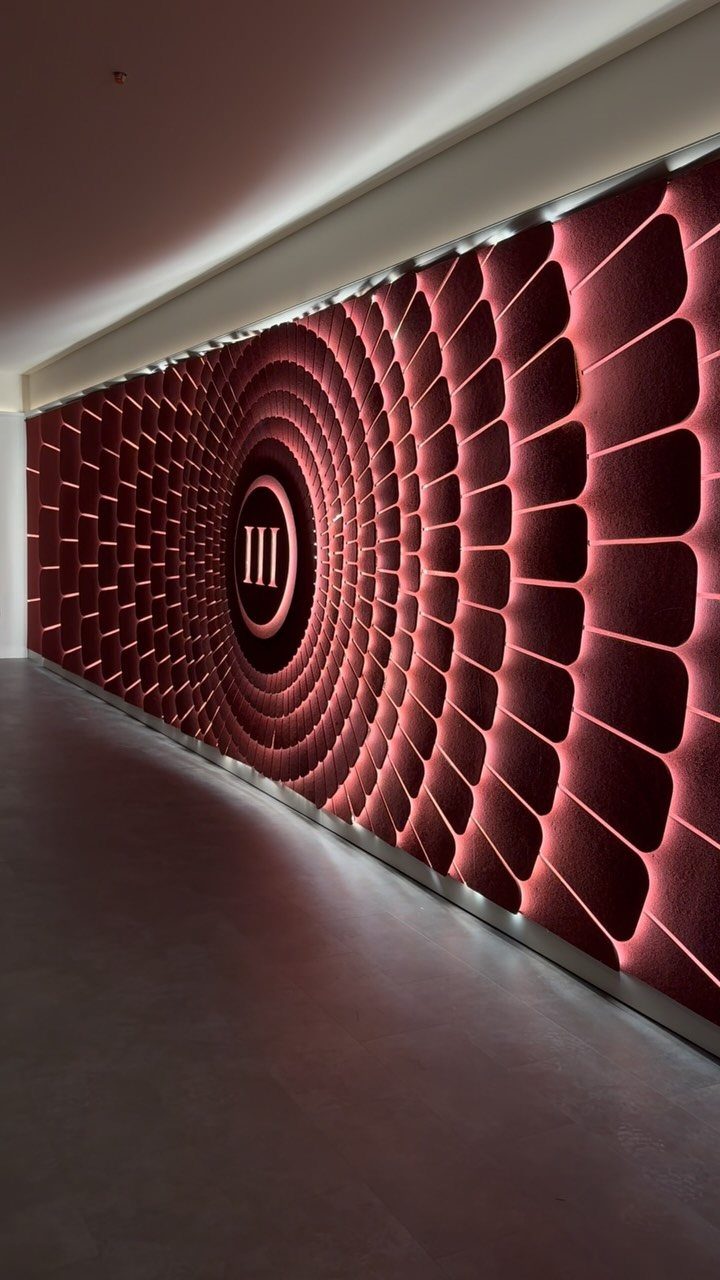
Backlit concentric circles turn an acoustic wall into a light fixture. The red textured surface reads as sculpture because the LED behind each ring casts shadow forward into the tunnel of petals.
The build is panelized: concentric rings of acoustic composite in moderate thickness, mounted on standoffs from the wall so light washes the back edges.
The center plaque with Roman numeral III suggests this is wayfinding in a commercial corridor, but the same logic works above a bed or in a media room where you want dim ambient light.
I would use tunable white LEDs, not fixed warm, since the red surface will shift whatever color you put behind it. Power runs through the wall to a junction; a plug-in cord defeats the floating effect.

【Excellent Quality】: This wall soundproofing foam board is made of high-quality 100% polyester, odorless and flame retardant. There are no risks associated with spending long periods of time in a room with acoustic foam panels. And compared with traditional sound-absorbing panels, our products have higher thickness (25% thicker) and density (35% denser),which means better durability and sound absorption.
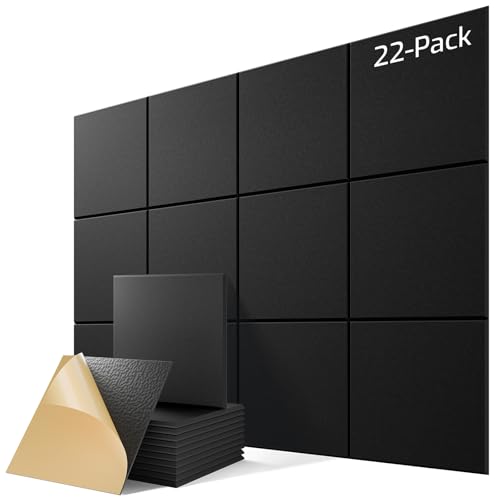
Superior Noise Reduction & Echo Cancellation - Tired of background noise and poor acoustics? Our soundproof wall panels are engineered with high-density acoustic foam that effectively absorbs noise, reduces echo and reverberation (RT60), and minimizes standing waves. Perfect for home office video calls, podcast studio recordings, or creating a quiet media room. Experience clearer speech intelligibility and a significant noise reduction for a more focused environment

【EFFICIENT NOISE REDUCTION】If you work or live in a noisy environment, then Amantech acoustic material will bring great convenience to your life. If you stick it on the wall/ceiling, you will greatly reduce hearing Noisy neighbors, but also reduce your chances of being complained about noise
6. Curved Slats with Integrated Backlighting
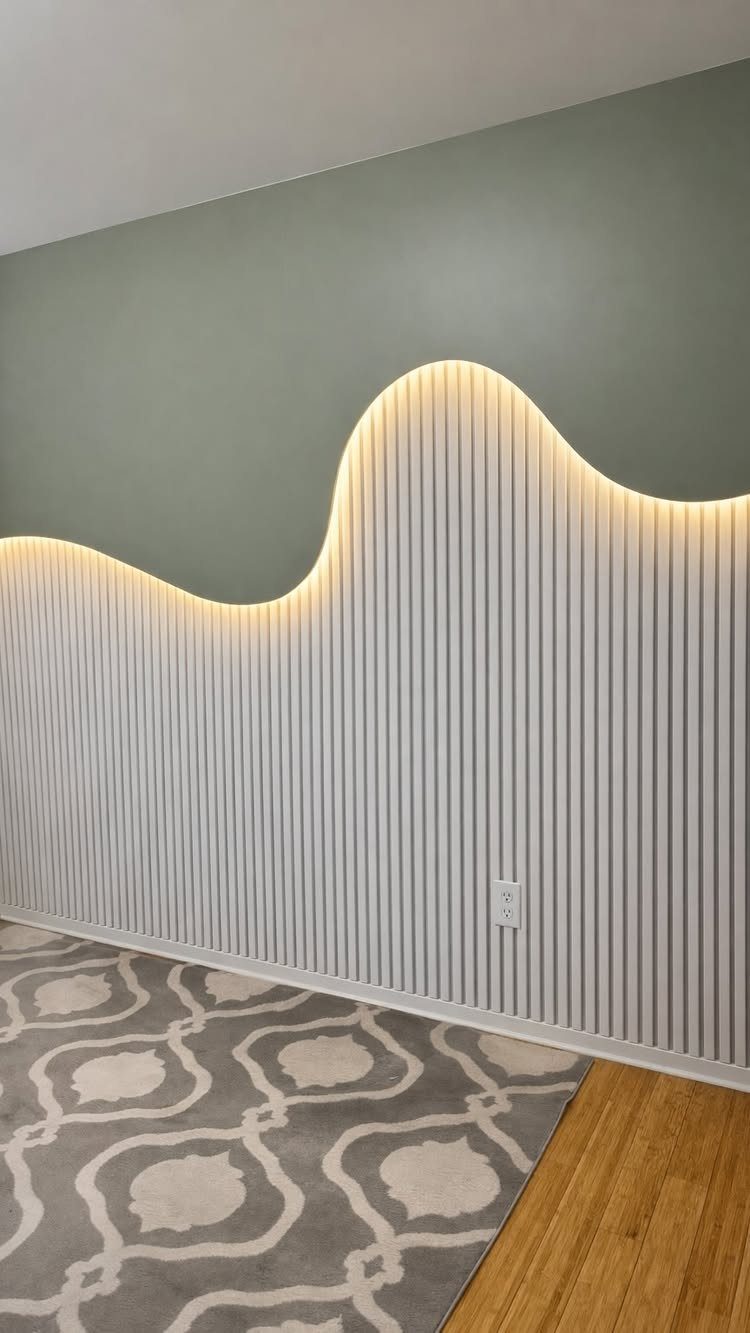
Curved slats with integrated backlighting keep the wave low and horizontal rather than climbing the wall.
White vertical slats with a wavy top edge have warm LED following the contour, which means the light source is visible as a glow line rather than hidden wash.
For a version I could build, I would use 1×3 pine or poplar, rip the wavy profile with a jig on the bandsaw, and groove the back for LED strip.
The acoustic value here is modest. The gaps between slats are too narrow and the backing too shallow for serious absorption.
I would add a layer of mineral wool behind the backer panel if this goes in a home theater or podcast corner.

Explore All Colors with Ease – Discover the perfect match for your space with our color samples plate. This compact and convenient sample plate includes all 12 colors of our wood wall panels, from Black to Traditional Walnut. Ideal for evaluating the aesthetic and quality of our sound proof panels for walls before making a purchase.

Recyclable Material: Olanglab wood 3D wall panels consist of MDF slats and acoustic felt backing, they are made of recyclable and reusable materials that contribute to promoting sustainability.

Acoustic Wall Panel Holder: this black acoustic panel hooks serves as acoustic wall panel holder that fits wood acoustic wall, applied for hanging coats, hats, towels, and bags in entryways, home offices, music studios, or living rooms for a clean, contemporary setup
Choosing the Right Panels
Start by naming the problem, not the product. Ringing echo, muddy speech, or noise that never stops: each needs a different approach.
Absorption fixes the first two; diffusers only help if the room already sounds dead.
Check what the room is working against. Glass, concrete, tile, and bare drywall all throw sound back hard.
The more hard surfaces, the more coverage you need.
Panel type follows from that. Fiberglass, PET felt, or foam for pure absorption; slat or perforated panels if you want some reflection left.
Mixed panels split the difference.
Placement beats pattern. First reflection points, where sound bounces straight from speaker to ear, matter more than total square footage.
Start there, expand if the problem persists.
Looks come last. Cleaning, impact risk, and whether the color still works when the LEDs fade: those determine if you live with the wall or hide it later.

Clearer room acoustics: Dense PET felt helps absorb reflected sound, reduce echo and control reverberation for a more comfortable listening environment in home offices, recording spaces, gaming rooms, bedrooms and media areas. These panels improve room acoustics; they are not designed to block sound transmission through walls.

𝗪𝗵𝗮𝘁 𝗬𝗼𝘂 𝗚𝗲𝘁 - 16 acoustic panels covering 15.5 sq. ft. in total (each: 11.8" × 11.8"). At just 0.4" thick, they deliver powerful sound absorption without the bulk of traditional foam. Target exactly where the echo is worst – behind speakers, around your desk. Achieve both superior sound control and stunning visual impact.

𝗪𝗵𝗮𝘁 𝗬𝗼𝘂 𝗚𝗲𝘁 - 16 acoustic panels covering 15.5 sq. ft. in total (each: 11.8" × 11.8"). At just 0.4" thick, they deliver powerful sound absorption without the bulk of traditional foam. Target exactly where the echo is worst – behind speakers, around your desk. Achieve both superior sound control and stunning visual impact.
Common Mistakes
Random placement is the most common mistake I see. Panels hung wherever the wall looks empty usually miss the paths where sound actually travels.
The first reflection points you need to treat are at ear level, where sound bounces from speaker or talker straight to the listener. Treat those zones before adding panels anywhere else.
Too little coverage leaves the room loud even where panels exist. Too much, and the space goes dead; pull some absorbers and add diffusers if speech starts feeling flat.
Thin panels on boomy bass is another miss.
Height matters. Panels above head level or far from the reflection path might look right and do nothing.
Ear-level routes first, then fill in.

Panel size is 24" x 24" x 2" and each panel weighs 3 pounds

Provides clearer, more enjoyable sound by effectively controlling unwanted reverb and echo.

EASY INSTALLATION. FISSURED ceiling tiles with a non-directional texture and a square edge cut easily and minimize waste and time during installation; 2x2 ceiling tiles
Acoustic Performance Enhancement
A wall of panels alone rarely solves everything. Bass builds in corners where parallel walls meet; that energy needs traps, not more of the same mid-range absorber.
Diffusers scatter what panels soak. Add them once absorption has gone too far and the room feels like a closet.
The balance depends on use: podcasts want dead, living rooms want alive.
Air gaps behind panels extend their reach downward in frequency. The same 2 inch panel on standoffs performs deeper than one glued flat.
I would plan that gap into the build rather than fix it after.
Ceiling and floor matter too. A treated wall with bare ceiling above a desk still lets sound loop over the panels.
Carpet or a ceiling cloud closes that path.
Think of the room as one system. Panels are the visible part, but the full treatment is where the sound goes and what stops it there.

ENJOY CLEARER SOUND EVERY DAY: Designed to help reduce echo and soften unwanted room noise, these decorative soundproofing panels create a more comfortable environment for working, watching movies, gaming or simply relaxing at home

Real 3D Design: Diamond pattern with 1 inch raise design makes our wall panels more eye-catching. A box comes in 33 tiles, which covers 32.Sq.Ft.

【Handcrafted Geometric Wood Wall Art – Unique 3D Texture for Modern Spaces】 Elevate any plain wall into a stunning focal point with our hand-assembled solid wood mosaic panels. Each piece features 36 precision-cut natural wood blocks with one-of-a-kind grain patterns, delivering a rich dimensional 3D texture that flat printed art and cheap foam panels cannot match. It pairs seamlessly with mid-century modern, farmhouse, boho, and minimalist interior styles, perfect for living room accent walls, TV backdrops, bedroom headboards, and home office decor.
Panel Design Trends
The current direction is panels that do not read as treatment. Neutral palettes, fabric wraps in colors that belong to the room rather than the studio, and shapes that resolve into architecture instead of add-on.
Slat systems lead because they pass as finished millwork. The acoustic work hides behind; the front reads as design choice.
Fabric-wrapped tiles follow, especially in offices where the alternative is bare drywall or industrial foam.
Modification around fixed objects matters more now. Panels cut to frame a mounted TV or run behind a sofa back signal that the treatment was planned with the room, not applied after.
What I would watch: color trends cycle faster than panel life. A loud pink dates itself fast; warm white or quiet grey stays neutral through a move or a repaint.
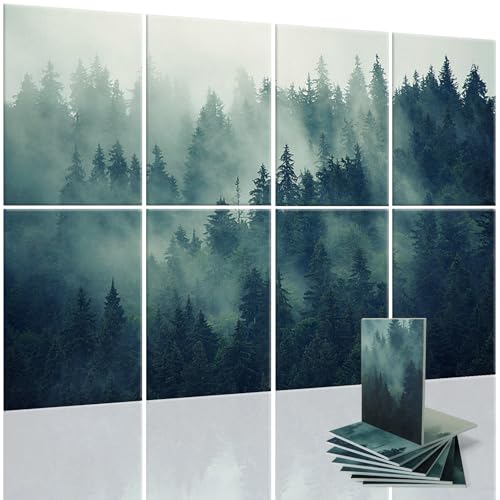
Superior Sound Absorption: Crafted with high-density polyester UV print material, these acoustic wall panels deliver exceptional soundproofing. Effectively reduce echoes, reverberation, and low-frequency noise, creating clearer, more immersive sound environments

Professional studio level acoustic treatment, create a beautiful recording environment!

【EFFICIENT NOISE REDUCTION】If you work or live in a noisy environment, then Amantech acoustic material will bring great convenience to your life. If you stick it on the wall/ceiling, you will greatly reduce hearing Noisy neighbors, but also reduce your chances of being complained about noise
Frequently Asked Questions
Are acoustic wall panels still in style?
They are, and the 2025 direction is toward panels that do actual acoustic work while looking like intentional design.
Wood slat panels with absorber backing, geometric fabric-wrapped forms in color, and backlit installations all treat the wall as a feature rather than hiding treatment in a corner.
The shift is from pure utility to something you would plan a room around.
How do I make a DIY acoustic wall?
Start with what the wall already is. Fabric-wrapped tiles in 2 foot by 4 foot, 2 inch thick, let you build stepped or arched layouts for color and pattern without touching a jigsaw to custom shapes.
Leave breathing room behind any cutout; flush against the wall bleeds out the low end.
How thick should acoustic wall panels be?
Thickness depends on what frequency you need to catch. Standard felt panels handle echo for speech and daily clatter, though they soften up when frequencies drop.
The 2 inch fabric-wrapped tiles I would use for a DIY geometric layout give a workable middle ground for most home spaces.